
The team at Glenwood Premier Dental Group is known for precision care and personalized treatment for even the most complex cases. They've helped countless patients save their teeth and restore their smiles.  Request a free consultation
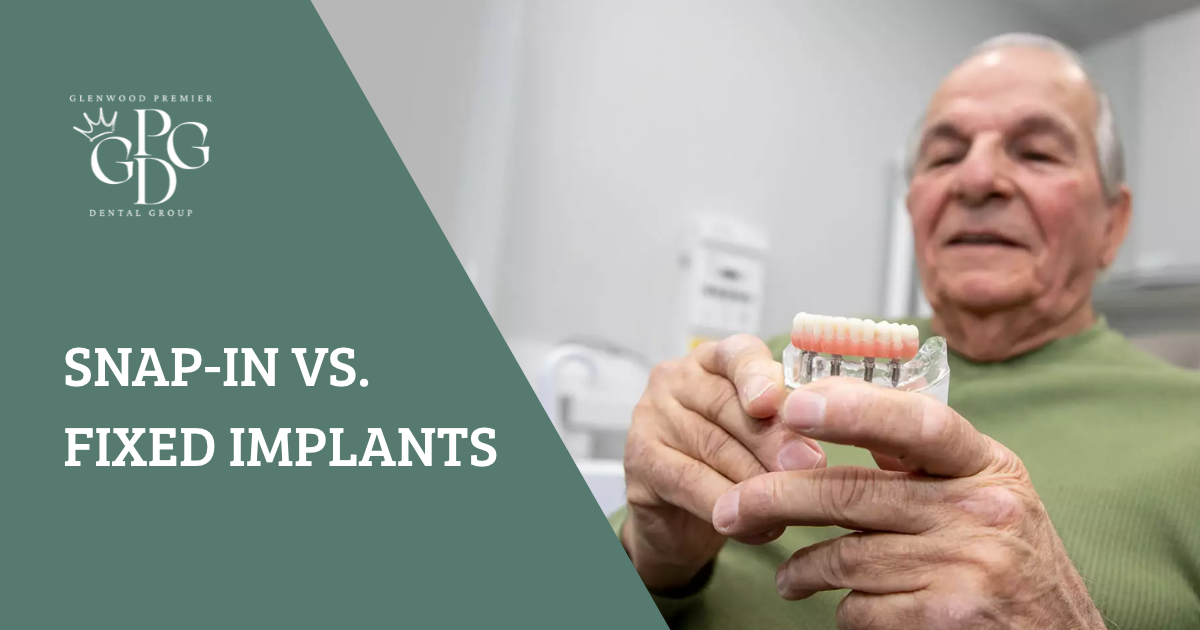
Snap-in dentures and fixed full-arch implants both use dental implants to hold your teeth in place, but they ask different things of you every day. Snap-in dentures cost less and come out at night. Fixed full-arch teeth cost more and stay in for good. The right choice depends less on which one is "better" and more on how you want to live with your teeth.
Most comparisons online read like a pitch for the more expensive option. Glenwood Premier Dental Group offers both, so here's the straight version: what each one does, where each falls short, and the four questions we use to help patients choose.
Both Options Use Implants, but Only One Stays In All the Time
The real difference between snap-in dentures and fixed full-arch teeth is whether your teeth come out at night. Everything else follows from that.
Snap-in dentures, also called implant-supported overdentures, clip onto two to four implants. Small attachments inside the denture lock onto matching attachments on the implants, so the denture stays put while you eat and talk. You remove it to clean it and usually to sleep. Upper snap-in dentures often still cover part of the roof of the mouth.
Fixed full-arch teeth are attached to four or more implants with screws, and only your dentist can take them off. At Glenwood, the final set is milled from a single block of zirconia. You brush and water-floss them in place, the way you'd care for natural teeth.
Both options hold far better than a traditional denture. Only fixed teeth stay in your mouth around the clock.
Snap-In Dentures Cost Less Up Front, and the Gap Narrows Over Time
Snap-in dentures are the lower-cost option on day one. At Glenwood, an implant-supported denture typically runs $8,000 to $12,000 per arch with insurance, or $10,000 to $15,000 without. A fixed full arch typically runs $15,000 to $25,000 per arch with insurance, or $20,000 to $35,000 without.
The ongoing costs run in the opposite direction. The attachments inside a snap-in denture wear out and get replaced periodically. The denture base needs relines as your gums change, and the denture itself is eventually remade. A zirconia fixed bridge still needs maintenance visits, but it doesn't have those recurring parts.
Our breakdown of dental implant cost in NJ covers what else goes into a quote. Snap-in dentures cost less to start, and the difference shrinks once you count 10 to 15 years of upkeep.
Glenwood's Four Questions for Choosing Between Snap-In and Fixed
At Glenwood Premier Dental Group, these are the four questions we use to help patients decide between snap-in dentures and fixed full-arch teeth. They matter because, as Dr. Wassef puts it, "two people can come in with the same exact scenario, but want two different outcomes."
1. How Do You Feel About Taking Your Teeth Out Every Night?
If taking your teeth out bothers you, that alone often settles it in favor of fixed. For some people, removing a denture at night is a two-minute routine they barely think about. For others, it's a daily reminder of losing their teeth. Fixed teeth never come out, so the question disappears.
2. What Do You Want to Be Able to Eat?
Fixed teeth chew the most like natural teeth. Glenwood's fixed full-arch teeth restore over 98% of natural oral function. Snap-in dentures are far more stable than regular dentures, but they rest partly on the gums, so very hard or chewy foods can still be a challenge. An upper snap-in that covers the palate can also dull the taste and temperature of food.
3. What Does Your Bone Support Right Now?
Snap-in dentures can work with fewer implants and less bone. A lower snap-in denture can be held by as few as two implants, which can mean a shorter surgery and less grafting. Fixed teeth need enough bone for four or more implants, though angled implants often work with bone patients don't realize they still have. A 3D scan answers this question, and our guide to whether you need a bone graft for implants explains how.
4. What Can You Spend Now, and What About Later?
Budget for the next 10 to 15 years, not only for this year. If fixed teeth are out of reach right now, a snap-in denture can get you stable teeth sooner. Ask whether your implants could later support fixed teeth. That depends on how many implants are placed and where, so it's worth planning from the start.
If your answers lean toward "removing them bothers me," "I want to eat everything," "my scan supports it," and "the budget works," fixed teeth are likely your match. If two or more point the other way, a snap-in denture may serve you better.
Snap-In Dentures Are the Right Choice for More Patients Than You'd Expect
A snap-in denture is a strong option in several common situations. A lower jaw with no teeth is the clearest example. A 2002 consensus statement from McGill University recommended a two-implant overdenture as the minimum standard of care for a toothless lower jaw.
Snap-ins also make sense for patients who want a shorter surgery with fewer implants, people managing health conditions that make a longer procedure harder, and anyone who prefers to take their teeth out to clean them. For older patients weighing these trade-offs, our guide to full-arch dental implants after 65 covers the health questions in more detail.
A snap-in denture chosen for the right reasons is a good result in its own right.
Fixed Teeth Make More Sense When You Want Them Out of Your Daily Routine
Fixed full-arch teeth are the better fit when you want your teeth to stop being something you manage. That usually means patients who never want to remove their teeth, people who want to eat anything without thinking about it, and upper-arch patients who want the roof of the mouth left open.
Long-time denture wearers often land here. After years of adhesives and slipping, many want nothing removable at all. Our post on switching from dentures to fixed dental implants covers what that transition involves.
Fixed teeth cost more because they replace the most of what you lost: teeth that stay in, chew normally, and need no nightly routine.
Find Out Which Option Fits Your Bone, Your Budget, and Your Day
The quickest way to choose is to see both options priced against your own scan. At a consultation with Glenwood Premier Dental Group in Hazlet, NJ, you'll get a 3D scan, a quote for each option that fits your case, and an honest recommendation based on the four questions above.
For a side-by-side look at every option, from traditional dentures to snap-ins to fixed zirconia teeth, see our page on fixed vs. removable teeth.
The best option is the one you'll be glad to live with every day, and that answer is different for every patient.


