
The team at Glenwood Premier Dental Group is known for precision care and personalized treatment for even the most complex cases. They've helped countless patients save their teeth and restore their smiles.  Request a free consultation
Two full-arch implant quotes can describe what sounds like the same treatment and still differ by thousands of dollars. Very often, the difference is the material the final teeth are made from. Zirconia final teeth cost more up front and typically last 15 to 20 years or longer. Acrylic final teeth cost less and usually need major repair or replacement within about 10 to 12 years.
That makes the material one of the biggest decisions in a full-arch case, and it's the one patients ask about least. Most people compare the number of implants, the timeline, and the total. Few ask what they'll actually be chewing with for the next two decades.
At Glenwood Premier Dental Group, we treat the final material as part of the treatment plan rather than an upgrade line at the bottom of the invoice. Here's what each material does well, where each one falls short, and the five questions that tell you what a quote really includes.
The Teeth You Leave With on Surgery Day Are Usually a Temporary Set
At most practices, the teeth attached on surgery day are an acrylic temporary, and the real material decision is the final set placed three to six months later. The temporary is acrylic on purpose. Your gums and bone keep changing shape while the implants heal, and acrylic is light, easy to adjust, and easy to repair if it cracks during that stretch.
Some practices advertise final zirconia teeth within 24 hours of surgery. It's a fair question to ask how a final set made before your gums finish settling will fit once they do. Our post on teeth-in-a-day full-arch implants covers that trade-off in detail.
Either way, the temporary is not what you'll live with. The material question that matters most is what your final teeth are made of, because that's the set you'll chew with for the next 15 years or more.
Acrylic and Zirconia Wear Out in Different Ways
Acrylic wears down gradually and is cheap to fix along the way. Zirconia barely wears at all, but it's harder to adjust once it's made, and it depends on a carefully balanced bite.
Acrylic on a metal frame | Monolithic zirconia | |
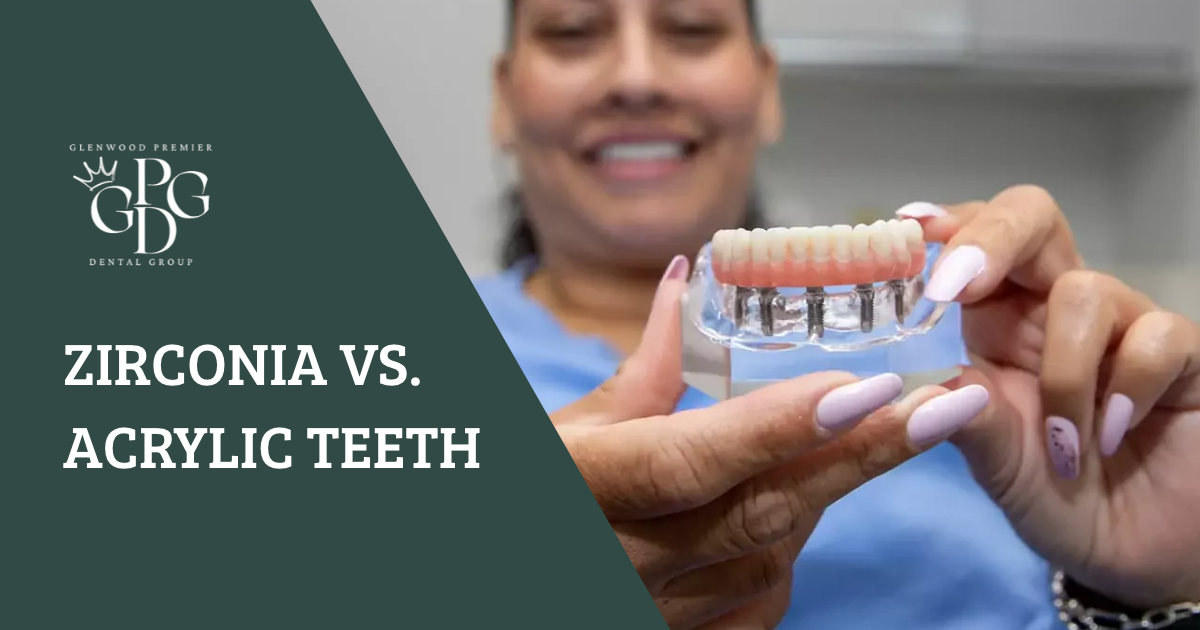
What it is | Acrylic teeth and pink acrylic gums over a metal bar | Milled from one solid block of zirconia |
Typical lifespan | About 10 to 12 years before major repair or replacement | 15 to 20 years or longer |
How it wears | Teeth wear down, chip, and stain over time | Very little wear; can chip or crack if the bite isn't balanced |
Repairs | Quick, inexpensive chairside fixes | Hard to modify once made; major damage often means a remake |
Plaque and odor | Collects more plaque and odor as the surface ages | Dense, smooth surface that resists plaque |
Up-front cost | Lower | Higher |
Acrylic's weakness is time. A chipped acrylic tooth is a simple repair, but chips, wear, and staining add up, and by year ten many acrylic sets need to be rebuilt or replaced.
Zirconia's weakness is precision. It handles heavy chewing and even grinding well, but only when the bite is balanced and checked at follow-up visits. If it does crack, the fix usually costs more than an acrylic repair.
Acrylic fails slowly and cheaply. Zirconia rarely fails, but when it does, the repair is bigger.
The Material Is Often the Hidden Gap Between Two Quotes
When one full-arch quote comes in far below another, check what the final teeth are made of before you compare totals. A noticeably lower quote usually prices one of three things differently:
The final teeth are acrylic rather than zirconia.
The quote covers only the temporary set, and the final teeth are billed later.
Extractions, sedation, or 3D imaging are left out and added once treatment starts.
The first one is the easiest to miss, because both versions get called "permanent teeth." An acrylic final set may cost less today, then need a rebuild or a full replacement around year ten. Add that second set to the original price, and the cheaper quote can end up costing about the same or more over 20 years.
Our breakdown of full-arch dental implant cost in NJ covers the other line items worth checking. A lower quote is only lower if it covers the same final teeth.
Acrylic Final Teeth Can Still Make Sense in a Few Situations
Zirconia is the stronger long-term choice for most full-arch cases, but acrylic is a reasonable decision in two specific situations, as long as you know the trade-off going in.
When the Budget Makes Zirconia Unrealistic Right Now
An acrylic final set can get you into fixed teeth sooner. The implants are the long-term foundation, and a worn acrylic set can often be replaced with zirconia later on the same implants. Ask up front whether that upgrade path is possible in your case and what it would cost.
When the Case May Need Changes Later
Acrylic is much easier to modify than zirconia. If there's a real chance the plan will change, such as an implant that needs extra monitoring or a bite that's still being refined, a material that can be adjusted chairside has value.
Choosing acrylic is fine when it's a decision you made with the facts. It's a problem when it's buried in a quote and you only find out at year ten.
Five Questions That Reveal What a Full-Arch Quote Really Includes
At Glenwood Premier Dental Group, these are the five material questions we encourage every patient to ask about any full-arch quote, including ours. A practice that does this work well will answer each one specifically.
1. Does the Price Cover the Temporary Teeth, the Final Teeth, or Both?
It should list both, separately. If the quote only mentions "teeth" or "a new smile," ask which set the number pays for and what the other one costs.
2. What Material Will My Final Teeth Be Made From?
The answer should name a material, such as monolithic zirconia or acrylic on a titanium frame. "Permanent teeth" describes how they attach, not what they're made of.
3. How Long Should That Material Last, and What Does Replacing It Cost?
You want an expected lifespan and a ballpark replacement cost. That's what lets you compare a lower quote against a higher one over 15 or 20 years instead of on day one.
4. Who Makes the Final Teeth?
The practice should be able to name its dental lab and say how long they've worked together. Fit and finish come from that relationship, which is one of the factors in how to choose a full-arch implant dentist.
5. What Happens If the Final Teeth Chip or Crack?
Ask what's repaired, what's remade, and what you'd pay for each. Ask too how the bite and the teeth get checked over time, because regular one-year and five-year check-ins after full-arch implants are what catch wear early.
If a practice can answer all five with specifics, you know what you're buying. If it can't, the quote isn't finished.
When Final Teeth Wear Out, the Implants Usually Stay
Replacing a worn set of full-arch teeth usually means making new teeth for the implants you already have, not another surgery. The implants are designed to last for decades. The teeth on top run on a different clock, which is why the material choice shows up again years later.
A few habits stretch that clock for either material. A night guard protects the teeth if you grind. Regular visits catch loose screws and small chips before they spread. Good daily cleaning under the bridge keeps the gums around the implants healthy.
Our guide to life with full-arch dental implants covers what that routine looks like. The implants are a long-term foundation, and the material on top decides how often you'll rebuild what sits on it.
Bring Your Quote and Ask Us the Same Five Questions
If you're comparing full-arch quotes, the fastest way to find the real difference is to put the material on the table. Bring any quote you've received to a consultation at Glenwood Premier Dental Group in Hazlet, NJ, and ask us the same five questions.
You'll get a 3D scan, a treatment plan that names the material for both your temporary and final teeth, and a cost for each. If you'd like to see what we use for final teeth, our page on zirconia implant bridges shows the material up close.
The number at the bottom of a quote only means something once you know what it's buying.


