
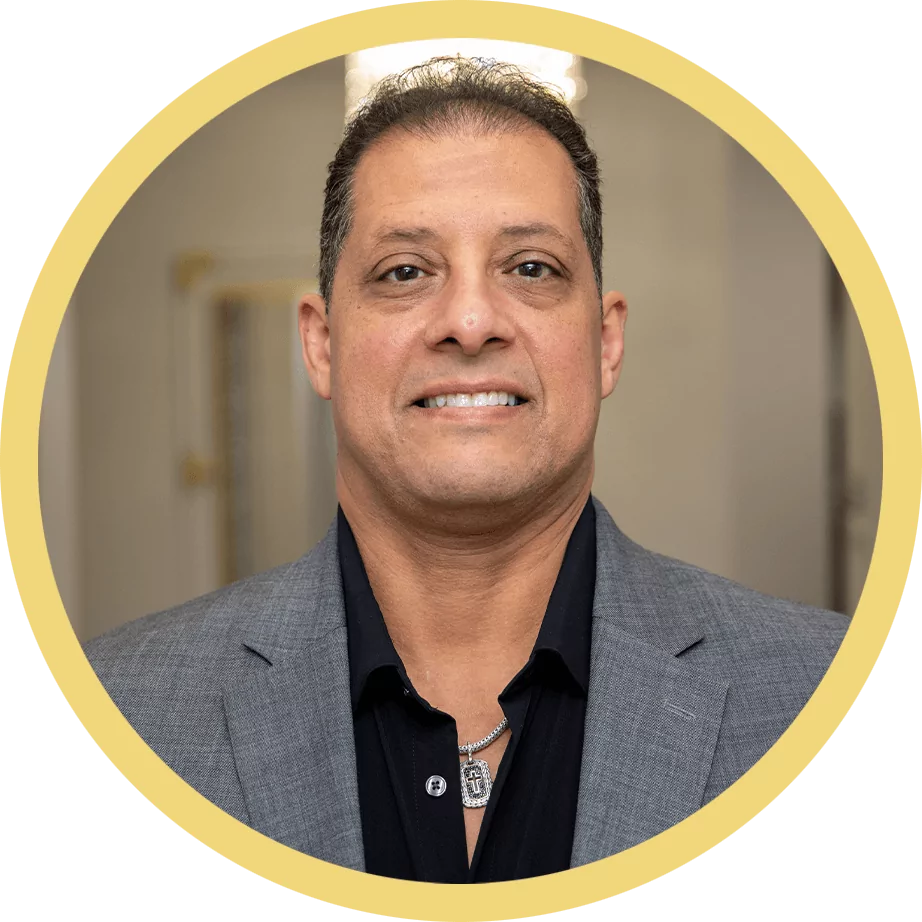
Dr. Wassef is an experienced dentist serving patients in Hazlet, Holmdel, and surrounding NJ communities. Known for precision care and personalized treatment for even the most complex cases, he’s helped countless patients save their teeth and restore their smiles.

Most patients choose an implant dentist based on criteria that don't correlate with outcomes: Google review count, marketing budget, price point, or convenience of location. The criteria that actually predict good long-term results are different, more specific, and rarely mentioned in the practices you're comparing.
If you're evaluating providers for full-arch implant treatment, here's what to look for, what to ignore, and how to know whether the practice in front of you should be doing this work.
Why most patient evaluation criteria don't predict outcomes
The dominant way patients evaluate implant dentists follows a predictable pattern. They check Google reviews, look at the practice's marketing, compare quotes, and often choose the cheapest option or the one with the most polished ad campaign. None of that predicts whether the practice will place their implants correctly, plan their case well, or be there when something needs adjusting five years later.
Reviews are a proxy for patient experience, which correlates weakly with clinical outcomes. Marketing spend correlates with a practice's ability to attract patients, not with its ability to serve them. Price correlates with what the practice charges, which is affected by many variables besides quality. Location correlates with convenience, which matters after the decision is made but not for the decision itself.
The criteria that actually correlate with outcomes are different. They're about the practice's training, its equipment, its case volume, its protocol range, and its follow-up model. Some are visible on a website. Others require asking specific questions. All of them are worth checking before signing anything.
Six things that actually matter when choosing an implant dentist
At Glenwood Premier Dental Group, these are the six criteria that separate practices set up to handle full-arch implant cases from practices that shouldn't be attempting them.
1. Case volume specifically for full-arch treatment
Experience matters. Experience with full-arch cases specifically matters more than general implant experience.
A dentist who has placed thousands of single-tooth implants but only a handful of full-arch cases isn't the same as a dentist who has completed hundreds of full-arch cases. Full-arch treatment involves surgical planning, prosthesis design, and long-term maintenance that don't automatically transfer from single-implant experience. The differences are large enough that case volume for full-arch specifically is one of the strongest predictors of outcomes.
The question to ask: how many full-arch cases has the practice completed, and how many does it complete per year currently? A practice that does full-arch treatment as a regular part of its work will have a specific number. A practice that treats it as an occasional service will hedge the answer.
2. Specific training and credentials in implant dentistry
Any dentist can legally place implants. Not every dentist has training that specifically prepares them for complex cases.
The credentials worth checking include Diplomate status with the International Congress of Oral Implantology (ICOI), Fellowship or Mastership with the American Academy of Implant Dentistry, and specific training in advanced techniques like bone grafting, sinus lifts, and angled-implant protocols. These aren't the only meaningful credentials, but their absence often indicates that the provider is doing implant work as a general dentist rather than as a specialist.
The question to ask: what specific training does the primary provider have in full-arch implant treatment? A specific answer names the training program, the certification, and the year completed. A vague answer is a sign that the training isn't as central to the provider's work as it should be for this type of case.
3. 3D imaging and digital surgical planning in-house
Full-arch cases planned on 2D X-rays produce worse outcomes than cases planned on 3D CT scans. That's a substantial gap. It's the difference between guessing at bone quality and knowing it.
Practices with 3D imaging (cone beam CT) in-house can plan cases accurately, produce custom surgical guides, and place implants exactly where the bone supports them. Practices without 3D imaging in-house either refer patients out for scans (adding time and disconnection between imaging and planning) or make decisions on incomplete information.
The question to ask: does the practice have 3D CT imaging in-house, and is it used for every full-arch case? The right answer is yes to both. A practice that uses 3D imaging only for "complex cases" is not using it enough. Every full-arch case is complex enough to warrant it.
4. In-house or closely partnered dental laboratory
The prosthesis is what the patient wears every day. Its fit, design, and material determine the long-term outcome as much as the surgical placement does.
Practices that work with high-quality dental laboratories (either in-house or through a close, long-term partnership) produce better prostheses than practices that outsource to whatever lab returns the fastest quote. The difference shows up in fit, in aesthetics, in longevity, and in the ability to adjust or repair the prosthesis over time.
The question to ask: what dental lab does the practice work with, and how long have they worked together? A specific lab name and a multi-year working relationship indicate that the practice controls its prosthesis quality. Vague answers or lab rotation indicate that they don't.
5. Range of protocol options for different cases
Practices that offer only one protocol (usually All-on-4, sometimes with immediate loading) treat every patient the same. Practices that offer a range of protocols (All-on-4, All-on-6, All-on-X variations, staged loading when appropriate, zygomatic implants for advanced cases) treat each patient as an individual.
The reason this matters clinically: not every patient's anatomy fits every protocol. A practice that only offers one option will fit patients to the protocol rather than the protocol to the patient. That produces acceptable results for the patients who genuinely fit, and worse results for the ones who don't.
The question to ask: what protocol options does the practice offer, and how do they decide which fits a specific case? The right answer names multiple protocols and describes a decision framework. A wrong answer is a version of "we usually do X."
6. Long-term follow-up and maintenance protocol
Full-arch implants are a multi-decade investment. The practice that places them is the practice you'll be seeing for maintenance for years afterward, and the quality of that follow-up affects long-term outcomes as much as the placement itself.
Practices set up for long-term relationships have structured follow-up protocols: specific visit schedules, implant-specific hygiene training for staff, clear escalation paths when something looks off, and a stable clinical team the patient can build a relationship with. Practices set up for one-time transactions don't have any of that.
The question to ask: what does long-term maintenance look like at this practice, and what happens if I have a concern between scheduled visits? A specific answer describes the maintenance schedule, the tools used, and the availability of the practice for unscheduled issues. A vague answer indicates that maintenance is an afterthought.
Four things that don't predict outcomes (even though they feel like they should)
The following criteria feel meaningful to most patients evaluating providers. They aren't. They can be tie-breakers between comparable practices, but they shouldn't drive the decision.
1. Google review count
Reviews correlate weakly with clinical outcomes. A practice with hundreds of five-star reviews might be excellent at patient experience while producing average clinical results. A practice with fewer reviews might produce exceptional clinical results while being less focused on review generation. Reviews are worth reading for red flags (patterns of complaints about specific issues), but the overall count and rating shouldn't drive the decision.
2. Marketing budget and advertising presence
A practice that runs aggressive local ads, appears at the top of search results, and has polished branding is a practice that invests in marketing. That correlates with the practice's ability to attract patients, not with its ability to serve them well clinically. Some excellent practices market heavily. Some don't market at all. The correlation with outcomes is essentially zero.
3. Lowest quote
Price alone tells you nothing about what's included in the quote or what the outcome will be. A low quote that omits imaging, sedation, or follow-up work is more expensive in the long run than a higher quote that includes everything. A low quote from a practice using acrylic prostheses is not comparable to a higher quote from a practice using zirconia prostheses.
The full-arch cost post covers what should be in a real quote and how to compare providers honestly.
4. Convenient location alone
Convenience matters — patients travel to the practice for surgery, for follow-ups, and for years of maintenance visits. But it should be a tie-breaker between comparable practices, not the primary criterion. Choosing a mediocre local provider over an excellent provider thirty miles further away for the sake of a shorter drive is a decision most patients regret when they discover the outcome quality gap.
How to actually run the evaluation
Three steps produce a real evaluation of a prospective implant dentist.
The first is a specific set of questions asked at the consultation. The six criteria above generate the questions: case volume for full-arch specifically, training and credentials, in-house 3D imaging, dental lab relationships, protocol range, and long-term maintenance model. Practices that can answer all six in specific terms have thought about their work carefully. Practices that hedge or generalize haven't.
The second is comparing at least two providers before deciding. Patients who see only one practice don't have a reference point for evaluating what they're being told. Patients who see two or three notice the differences immediately. The second opinion doesn't have to lead to switching. It has to give the patient a basis for comparison.
The third is checking the answers against verifiable evidence. Case volume claims should match the practice's actual patient photos and testimonials. Training credentials should match publicly listed member directories (ICOI and AAID both maintain them). In-house imaging should be visible when you tour the office. Dental lab relationships should be explainable when asked.
Practices that pass all three steps are the ones set up to handle full-arch cases well. Practices that don't are the ones patients should keep looking past.
What this looks like at Glenwood
Dr. Wassef has completed hundreds of full-arch cases over more than two decades of implant practice. He holds Diplomate status with the ICOI and a Mastership in advanced laser periodontics, oral surgery, and bone grafting. Glenwood Premier Dental Group uses 3D CT imaging in-house for every implant case, works with a long-standing dental laboratory partner, offers the full range of protocols (All-on-4, All-on-6, zygomatic implants for advanced cases), and has a structured long-term maintenance protocol that patients are onboarded to before their final prosthesis is placed.
This section isn't meant as self-congratulation. Each of those specifics is verifiable, and every criterion above is one the practice is willing to be evaluated on. That's the posture any provider should take.
The evaluation is worth doing before you commit
Full-arch implant treatment is a decade-plus commitment to a provider. The evaluation that gets you to that decision is worth the hour it takes. Providers who resist the evaluation, hedge on their answers, or push you toward a decision before you've completed it are telling you something.
Schedule a free consultation with Dr. Wassef at Glenwood Premier Dental Group in Hazlet, NJ. You'll get a 3D scan, a specific treatment plan, and direct answers to the six questions above. If you've been to other providers and want a comparison point, that's exactly what a real second opinion is for. For patients who've been turned down for full-arch treatment elsewhere, the second-opinion post for patients told no walks through what the evaluation should specifically cover.