
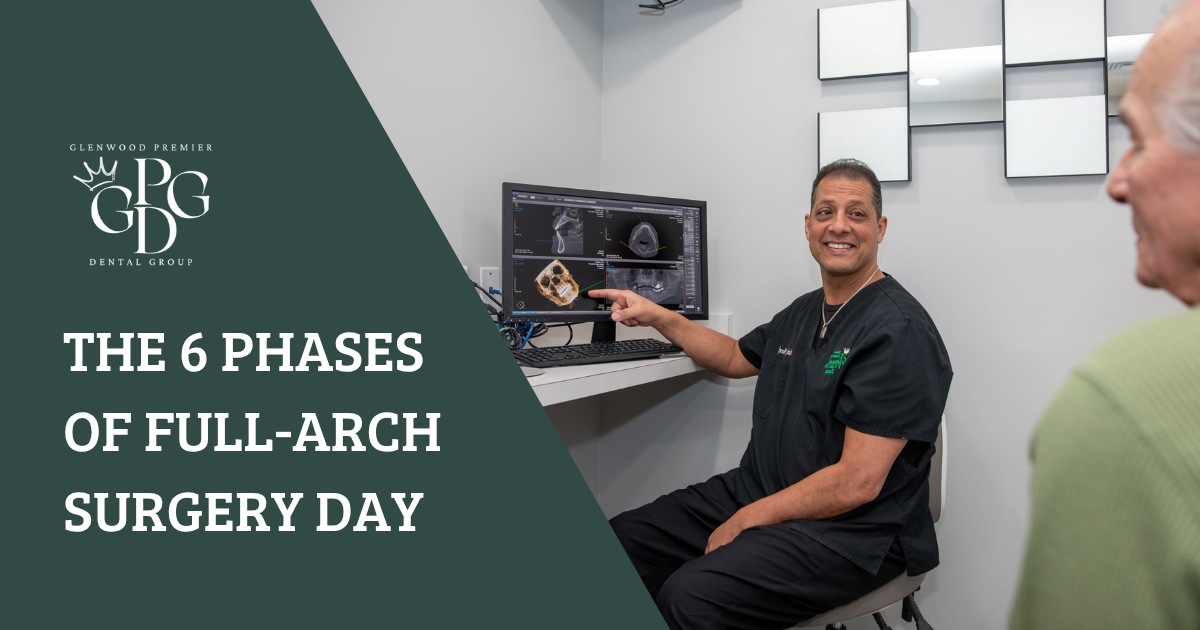

The team at Glenwood Premier Dental Group is known for precision care and personalized treatment for even the most complex cases. They've helped countless patients save their teeth and restore their smiles.  Request a free consultation
Surgery day has a specific rhythm. Arrival, preparation, procedure, recovery in the office, transition home, first evening. Understanding the rhythm before you're in it reduces the anxiety of not knowing what comes next, and helps you prepare in the practical ways that make the day easier.
Most content about full-arch implant surgery covers the clinical steps: where the incisions go, how the implants are placed, what osseointegration means. That's useful for understanding the treatment. It's not what the patient actually needs the day before surgery. What the patient needs is the experiential version: what time to arrive, what to bring, what happens hour by hour, what the drive home is like, and what to have ready when they get there.
Why the Clinical Version of Surgery Day Isn't What Patients Actually Need
Most practice websites walk patients through the surgical procedure step by step. The gum is opened. The implants are placed at specific angles. The temporary is attached. Sutures are placed. This is accurate information, and it's not what reduces surgery-day anxiety.
Patients aren't afraid of the clinical steps. They're afraid of the unknown. What time do I need to arrive? Will I be alone in the waiting area? Who will explain what's happening? How long will I be there? Will I walk out on my own, or will someone need to guide me? What will I feel like on the drive home?
The experiential version of surgery day answers those questions. That's the version this post covers.
The Six Phases of Surgery Day, From Arrival to First Evening at Home
At Glenwood Premier Dental Group, surgery day breaks into six phases with predictable patterns. Each phase has specifics worth knowing in advance.
1. The Morning Before You Arrive
Most surgery-day mistakes happen before the patient leaves the house. Preparation the morning of matters more than most patients expect.
If you're receiving IV sedation or general anesthesia, you'll have been given fasting instructions (typically no food or drink for six to eight hours before). Follow them precisely. Fasting isn't arbitrary. Anesthesia providers need an empty stomach to administer sedation safely. Patients who eat "just a small snack" the morning of get their surgery rescheduled.
If you're receiving oral sedation or local anesthesia alone, you'll have different pre-op instructions. A light meal is often permitted. Follow whatever the practice provided in writing rather than assuming what applies.
Take any medications the practice specifically approved (typically a pre-medication for anxiety, sometimes a starting dose of an antibiotic). Skip any medications the practice specifically told you to hold (typically blood thinners with specific timing instructions from your prescribing physician). Bring a written list of everything you take regularly so the surgical team has it accessible if needed.
Wear comfortable, loose clothing. A button-down shirt is easier than a pullover after surgery because you won't need to lift anything over your face. Avoid perfume, makeup, contact lenses, and jewelry. Bring a case for your glasses if you wear them.
Arrange a driver. Sedation deeper than local anesthesia alone requires one. The driver should plan to stay through the entire appointment, not drop you off and return.
2. Arrival and Check-In
You'll arrive at the practice at your appointment time or slightly before. Most full-arch surgery appointments are scheduled for the morning to give patients the full day to rest and to give the surgical team a fresh start.
Check-in typically involves confirming your identity, reviewing the treatment plan one more time, and signing any remaining consent forms. The practice should have covered these forms at your pre-op appointment already, but the day-of review is standard.
You'll be brought back to a surgical suite, where the team will review your medical history one more time and confirm your sedation choice. This is your last opportunity to ask questions or adjust anything. Use it.
Vital signs (blood pressure, pulse, oxygen saturation) will be taken and monitored throughout the procedure. The equipment can look intimidating but is standard for procedures involving sedation.
The driver typically waits in a designated area with clear communication from the surgical team about expected timing and updates as the procedure progresses.
3. Preparation and Anesthesia
Before the surgical procedure itself begins, the team prepares you for what's ahead. This phase takes 20 to 45 minutes depending on the sedation level chosen.
For local anesthesia alone, preparation is relatively quick. The surgical site is numbed with injections, and the procedure begins once the anesthesia has taken effect. Patients are fully awake throughout.
For oral sedation, the pill is typically taken at check-in or shortly after, and the team waits for it to take effect (usually 30 to 45 minutes) before starting. Patients feel increasingly relaxed and drowsy during this window.
For IV sedation, the line is placed and sedation is titrated to the appropriate level. Patients typically remember the IV placement and then have limited memory of what happens afterward.
For general anesthesia, a board-certified anesthesiologist or CRNA manages the airway and the sedation depth. Patients have no memory of the procedure at all.
More on how to choose the right sedation level for your specific case is covered in the four sedation options for full-arch implant surgery. The choice affects nearly every other aspect of surgery day, so making it thoughtfully matters.
4. The Surgical Procedure Itself
The surgery typically takes two to four hours for a single arch and three to six hours for both arches, depending on case complexity, whether extractions are needed, and whether grafting is required.
From the patient's perspective, the experience during the procedure depends entirely on the sedation choice. Under local alone, you're aware of pressure, movement, and the sounds of the surgical team communicating. Under oral sedation, awareness is dimmer but still present. Under IV sedation or general anesthesia, most patients have no memory of the procedure at all.
Regardless of sedation, the practice team monitors vital signs throughout. Any adjustments needed to sedation depth, pain management, or positioning are made as the procedure progresses.
At the end of the procedure, the temporary prosthesis is attached to the implants. This is what the patient will wear during the healing period. Understanding what the temporary prosthesis actually feels like and what it can and can't do is worth reading before surgery day so you know what to expect from the moment you leave the office.
5. Recovery in the Office
After the procedure, patients spend time in a recovery area before being cleared to leave. This phase takes 30 minutes to two hours depending on sedation level.
For patients who received local anesthesia alone, the recovery period is short. Once the team confirms bleeding is controlled and the patient is alert, they're cleared to leave with post-op instructions.
For patients who received oral or IV sedation, the recovery period is longer. Patients are monitored as the sedation wears off. Some patients feel nauseous during this window (a common side effect of anesthesia), and the team can provide medication to help. Most patients are alert and comfortable enough to leave within one to two hours.
For patients who received general anesthesia, the recovery period is longest. The anesthesia team manages the wake-up process and doesn't clear the patient to leave until vital signs are stable and the patient is fully alert. This can take one to three hours.
During the recovery period, the surgical team goes over post-op instructions with both the patient and the driver. Written instructions are provided, but verbal review matters because sedated patients often don't retain what they hear. The driver is often the one who remembers the specifics.
The first pain medication dose is typically taken before leaving the office, so it's active by the time the local anesthesia wears off later. This pre-emptive approach prevents the acute pain window most patients fear.
6. Transition Home and First Evening
The transition from office to home is often more disorienting than patients expect. Sedation lingers. Fatigue from the procedure sets in. The reality of what just happened settles in slowly.
The drive home should be direct: no stops, no errands, no picking up prescriptions along the way. Any prescriptions should have been filled in advance so they're waiting at home. Ice packs, soft food, and a comfortable resting spot should all be ready before you leave for surgery in the morning.
Once home, most patients want to rest. Elevating the head with pillows during sleep helps reduce swelling. Ice application to the outside of the face during the first 24 hours also helps. Both are covered in the post-op instructions but are worth having set up before you arrive back home.
Eating during the first evening is usually light. Ice cream, yogurt, protein shakes, and other soft cold foods are the most common choices. Hot foods should be avoided during the first 24 hours because they can increase swelling. Chewing pressure should be avoided directly on the surgical sites.
The first pain medication dose taken before leaving the office will start wearing off during the evening. Following the medication schedule the practice provided rather than waiting for pain to develop is the pattern that produces the most comfortable first night.
Most patients sleep more than usual the first night. This is normal and expected. Sedation, the physical demand of the procedure, and pain medication all contribute to fatigue. Rest is what the body needs.
What to Have Ready at Home Before You Leave
The mistake most patients make is preparing home comfort after surgery rather than before. The morning of surgery is not when you want to be running errands. The evening after surgery is not when you want to be problem-solving what to eat.
Have these things ready before you leave the house for surgery: ice packs in the freezer, soft foods stocked (yogurt, applesauce, smoothies, protein shakes, mashed potatoes, ice cream), any prescription medications filled and accessible, a comfortable resting spot with extra pillows for head elevation, easy access to water, a phone charger within reach, and any post-op instructions from the practice printed or bookmarked.
Have someone available for the first 24 hours if possible. This isn't strictly required for most patients, but the presence of a family member or friend makes the transition easier, especially if unexpected discomfort or questions come up during the first evening.
What to Expect Emotionally During Surgery Day
The emotional experience of surgery day is often stronger than patients anticipate.
The morning before is often the peak of anxiety. Sleep the night before was probably disrupted. The anticipation of a multi-hour surgical procedure produces real physical tension. If your practice offers a pre-op medication for anxiety, this is when it helps most.
Arrival at the practice often produces a mix of relief and heightened anxiety: relief that the waiting is ending, anxiety about what's about to happen. Both are normal.
The procedure itself is different for every patient depending on sedation. Patients under local alone often report the experience as more manageable than they'd feared. Patients under IV or general anesthesia typically have no emotional experience of the procedure at all because they don't remember it.
Recovery in the office often produces surprise emotions. Some patients feel relieved and elated. Others feel drained and quiet. Some patients cry, either from emotional release or from the physical intensity of what just happened. All of these are normal.
The evening at home is often the most emotionally muted part of the day. Fatigue and pain medication reduce emotional intensity. Most patients describe the first evening as a blur of rest and quiet.
The morning after surgery is typically when the emotional processing catches up. Patients often describe waking up and realizing what happened. Understanding what to expect at each stage of the 90-day recovery timeline after full-arch implant surgery is worth reading to know what the following days and weeks will look like.
What to Ask Your Practice Before Surgery Day
Three questions worth asking at your pre-op appointment or by phone if any aren't clear:
The first: what's the specific arrival time, and how long should we plan to be there in total? Practices that can give you specific times have planned the day carefully. Practices that hedge ("just plan on being here all day") haven't.
The second: who is my point of contact during surgery, and who does my driver contact for updates? Family members often want updates during the procedure. Knowing who they should communicate with reduces anxiety on their end.
The third: what specific number should I call after hours if something comes up during the first night? Every practice should have an after-hours line for post-op concerns. Practices that don't are the wrong choice for a multi-hour surgery with a significant recovery.
Surgery Day Ends Better When It's Understood in Advance
Full-arch implant surgery is one of the more significant treatments in modern dentistry. The day of surgery is intense, physically demanding, and emotionally variable. Patients who understand the rhythm of the day in advance handle it better than patients who arrive without a clear picture of what's coming.
The practice's job is to make surgery day predictable, safe, and manageable. Your job as the patient is to prepare in the practical ways this post covers and to trust the team through what you can't control.
Schedule a free consultation with Dr. Wassef at Glenwood Premier Dental Group in Hazlet, NJ. You'll get a 3D scan, a treatment plan, and a direct conversation about what your specific surgery day will involve, including the sedation choice, the timeline, and the recovery support the practice provides. For more on what the days and weeks after surgery will look like, the 90-day recovery timeline after full-arch implant surgery covers the full picture.