
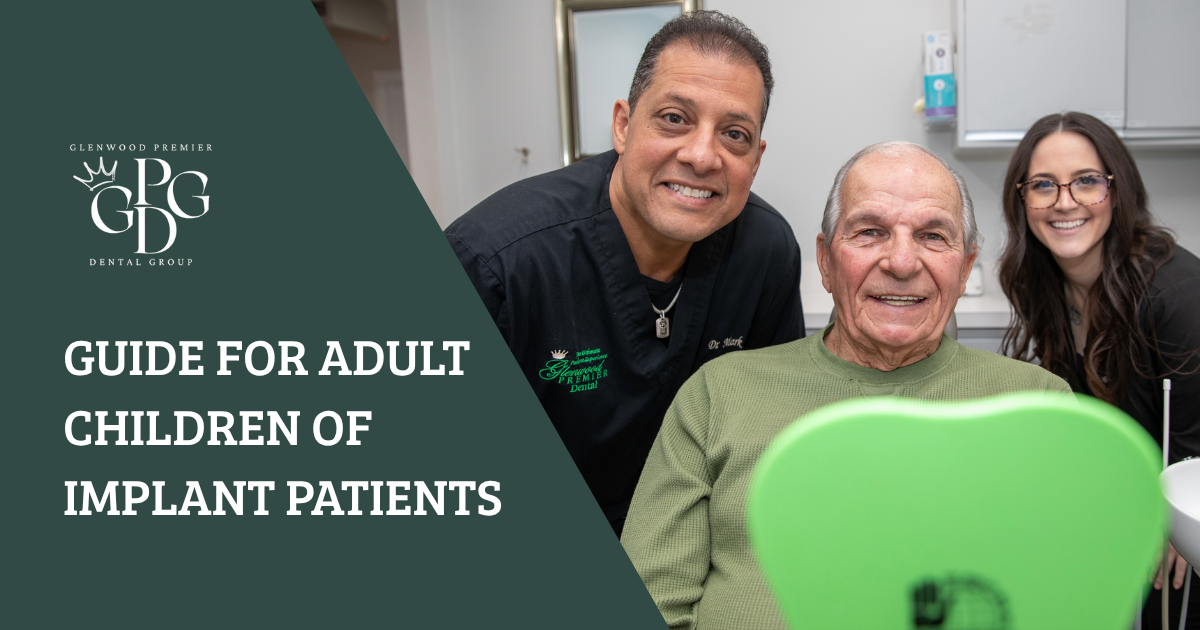

The team at Glenwood Premier Dental Group is known for precision care and personalized treatment for even the most complex cases. They've helped countless patients save their teeth and restore their smiles.  Request a free consultation
Adult children helping a parent through full-arch implant treatment can add real value in specific ways. Research support, consultation attendance, recovery assistance, coordination with medical care. What matters is that the parent stays in control of the decision. The family member's role is support, not decision-making.
If you're an adult child reading this on behalf of a parent, this post covers where you can genuinely help, where you should step back, and how to tell the difference. The goal isn't to manage your parent's treatment. The goal is to help them get the treatment they want, on their terms, with the practical support that makes the process easier.
Why the Adult Child's Role Is Both Real and Bounded
Adult children involved in a parent's medical decisions occupy a specific position. They often have more energy for research than the parent does. They have digital literacy that makes online comparison easier. They can attend appointments, ask questions, and take notes in ways that support the parent's decision-making. All of this is genuinely valuable.
They also have blind spots. The parent's medical decisions belong to the parent. Adult children who overstep, even from good intentions, often produce worse outcomes than adult children who help less. The parent whose treatment decision was effectively made by an adult child sometimes carries regret about the loss of autonomy, even when the clinical outcome is good.
The line between helpful and overstepping isn't always obvious. This post gives you a framework for staying on the right side of it.
Four Ways Adult Children Can Genuinely Help
At Glenwood Premier Dental Group, four categories of support consistently add value without crossing into decision-making. Each has specific things you can do and specific limits worth respecting.
1. Research Support
Full-arch implant treatment involves a lot of information. Cost breakdowns, protocol options, recovery timelines, provider comparisons, insurance and financing questions. Most parents doing this research alone find it overwhelming.
You can help by doing the research alongside your parent, not for them. Share links to articles they might find useful. Summarize longer content in ways that respect their intelligence. Ask them what they want to know rather than deciding what they need to know. Present options rather than recommendations.
The line worth watching: research support means giving your parent better information to make their own decision. It doesn't mean filtering the information to steer them toward your preferred outcome. If you find yourself downplaying a concern you disagree with or emphasizing an option you prefer, you've crossed into decision-making territory.
Understanding the six criteria for evaluating a full-arch implant dentist is one place your research can add real value, because provider selection is genuinely complex and requires comparing specific factors across multiple practices. Reading the framework yourself and bringing your parent the summary is useful. Deciding which practice they'll use isn't.
2. Consultation Attendance
Attending consultations with your parent is one of the highest-value ways adult children help. Two people hear more than one. Two people ask better questions. Two people remember more of what was said.
Ask your parent first whether they want you there. Some parents welcome the support. Others feel diminished by the presence of an adult child at a medical appointment. Both preferences are legitimate, and asking rather than assuming keeps the parent in control of the interaction.
If you attend, your role is note-taker and follow-up-question asker, not primary participant. The consultation is between your parent and the practice. You can add questions your parent forgot to ask, ask for clarification on technical points, or take notes on things worth reviewing later. You should not answer questions the practice directs to your parent, correct your parent's descriptions of their own symptoms or preferences, or make decisions on their behalf.
Practices set up for older patients typically welcome family members and know how to handle the dynamic well. If a practice you're considering seems uncomfortable with family attendance, that's worth noting.
3. Recovery Assistance
The recovery period after full-arch surgery involves several days of significant demand and several months of ongoing adjustment. Adult children who can help during this window add real value.
The first 72 hours are the most demanding. Someone to drive the parent home from surgery, help with medications on schedule, ensure they're eating and drinking, and be available if unexpected concerns come up during the first night is genuinely helpful. Understanding what to expect at each stage of the 90-day recovery timeline after full-arch implant surgery helps you know what's normal and what warrants a call to the practice.
The first two weeks involve continued but decreasing demand. Meal preparation, help with prescriptions, transportation to follow-up appointments, and general availability are all useful during this period.
The months of temporary prosthesis wear are lower-intensity but ongoing. Occasional check-ins about how your parent is feeling, help scheduling follow-up appointments, and support during any complications that come up are all valuable. Understanding what the temporary prosthesis actually feels like during the three to six months before final teeth helps you know what your parent is experiencing so you can support them appropriately.
The line worth watching: recovery assistance means providing the practical support your parent asks for or clearly needs. It doesn't mean taking over their daily routine or treating them as incapable. Ask what would be helpful. Respect their answer.
4. Coordination With Existing Medical Care
Older patients often have relationships with primary care physicians, cardiologists, or other specialists whose input matters for implant treatment planning. Adult children can help coordinate this communication.
You can help by making sure the parent has all their current medications and medical conditions documented and available for the dental practice. Confirming that the dental practice has requested any needed clearances from the parent's medical team. Following up on communication between providers if things stall. Attending medical appointments where implant treatment is discussed, if your parent wants you there.
The line worth watching: coordination means facilitating communication between providers who are all working for your parent. It doesn't mean making medical decisions on your parent's behalf or overriding the guidance of medical providers your parent trusts.
Three Things to Leave to the Patient
The four support categories above cover where adult children can add value. Equally important is what to leave to the parent.
1. The Decision About Whether to Pursue Treatment
Whether to pursue full-arch implant treatment is your parent's decision. Even if you strongly believe treatment would benefit them, even if you'd make a different decision in their position, the final call belongs to them.
Adult children sometimes bring up implants to a parent who hasn't considered them. That's fine as an introduction to the topic. It becomes problematic when the parent's initial reluctance is met with continued pressure over weeks or months. If your parent has heard about the option and decided not to pursue it, respect that.
The reverse is also worth watching. Adult children sometimes discourage parents from pursuing treatment they've decided they want, usually out of concern about cost or the physical demand of surgery. Both concerns are legitimate to raise once. Neither should become an ongoing campaign to change your parent's mind.
Family pressure is one of the documented causes of emotional regret patients report after full-arch implant treatment. Patients who felt pressured into treatment by family members report worse satisfaction with outcomes than patients who made the decision independently. This is worth taking seriously.
2. The Choice of Sedation, Timing, and Specific Treatment Details
The clinical decisions within treatment (which sedation option, when to schedule, which specific protocol) are your parent's choices to make with their dentist. You can be present for the conversation. You can help them process the information afterward. You should not push a specific answer.
Sedation is a common area where adult children try to steer. Some push for deeper sedation because they think it will be easier on their parent. Others push for lighter sedation because they're worried about anesthesia risk. Both concerns can be raised. Neither should become the deciding factor. Your parent's preference and the dentist's recommendation together should decide.
3. How They Feel About the Experience
Your parent's emotional experience of treatment is theirs. If they feel anxious, let them feel anxious. If they feel relieved, let them feel relieved. If they feel disappointed by an aspect of the process, let them express that without trying to correct the feeling.
Adult children sometimes try to manage their parent's emotions during treatment, either by minimizing concerns ("it's not that bad") or by amplifying reassurance ("you're doing so well"). Both come from good intentions and both can feel patronizing to the parent. The right response to your parent's emotional experience is usually to acknowledge it and ask what they need.
Common Tensions That Come Up in Practice
Even with the framework above, specific situations produce recurring tensions worth naming.
The first is disagreement about provider selection. You've done research and think a specific practice is the right choice. Your parent is inclined toward a different one, often based on factors you consider less important. This is worth one honest conversation and then acceptance. The decision is your parent's. If they choose a practice you'd have picked differently, help them succeed at the practice they chose rather than continuing to lobby for the alternative.
The second is disagreement about timing. You think your parent should proceed quickly. They want to wait. Or the reverse. Timing decisions belong to the patient. Raise your concern once, understand their reasoning, and respect the decision.
The third is disagreement about cost. Full-arch treatment is a significant financial decision, and adult children often have opinions about whether the money should be spent this way. Unless you're contributing to the cost, the financial decision belongs to your parent. If you are contributing, your input is legitimate, but the decision still belongs to them.
The fourth is emotional friction during recovery. The days after surgery can be physically demanding, and parents sometimes become short-tempered or emotional during that window. This isn't personal, and it usually passes within the first week. Patience serves the relationship better than reactivity.
What You Can Specifically Do This Week
If you're at the beginning of helping your parent think about full-arch treatment, four concrete steps are worth taking this week.
Ask your parent whether they want your help with research and decision-making. If yes, ask what would be most useful. Don't assume.
If they've indicated interest in treatment, offer to help them find and schedule an initial consultation. Understanding the age-specific considerations for full-arch implants in patients over 65 is worth reading first if your parent falls into that age group.
If they've already scheduled a consultation, ask whether they want you to attend. Respect either answer.
Regardless of where they are in the process, make sure they know you support their decision-making rather than trying to make the decision for them. Say it out loud. Your parent may not assume it, and hearing it can change how much they lean on you as a resource.
The Best Support Respects the Patient's Agency
Adult children who help well produce better outcomes than adult children who help less. Adult children who overstep produce worse outcomes than adult children who help less. The difference is respect for the patient's agency.
Your parent has lived their life making their own decisions. Full-arch implant treatment is a decision within that pattern, not an exception to it. The best support you can offer is the practical help that makes their decision-making easier, without trying to make the decision for them.
Schedule a free consultation with Dr. Wassef at Glenwood Premier Dental Group in Hazlet, NJ. Family members are welcome, and the consultation format supports both the patient and the family members who are helping them think through treatment. The consultation is where the process starts, and it should start with your parent as the primary participant.


