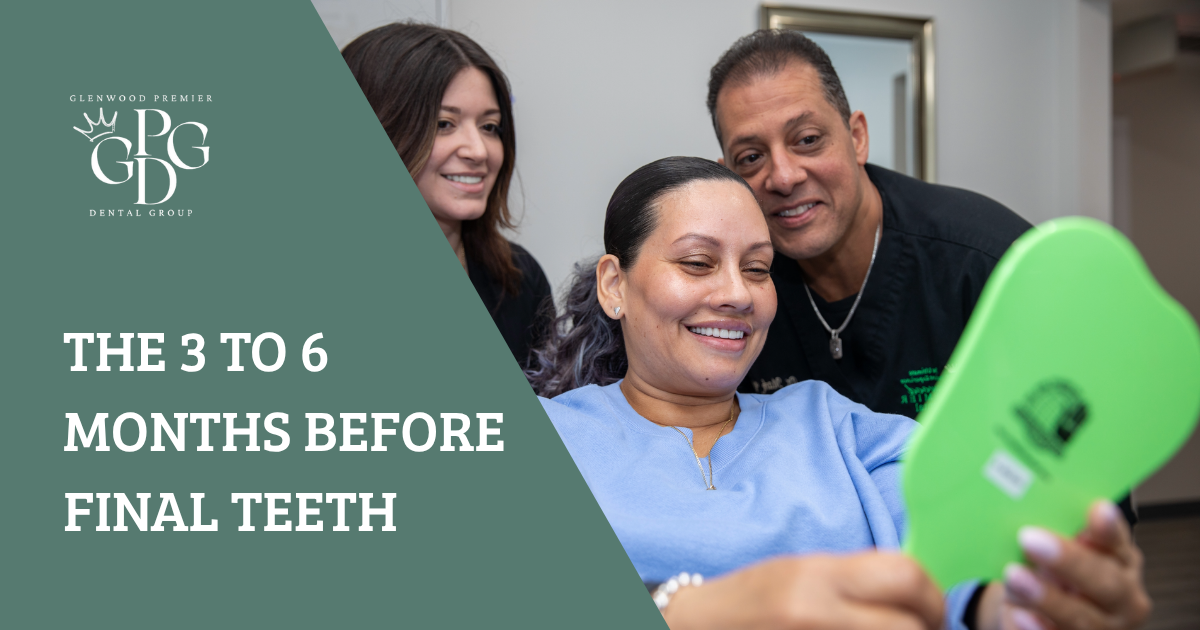

The team at Glenwood Premier Dental Group is known for precision care and personalized treatment for even the most complex cases. They've helped countless patients save their teeth and restore their smiles.  Request a free consultation
The temporary prosthesis is engineered for healing, not for the rest of your life. It's functional but different from the final teeth in specific, predictable ways. Patients who understand what the temporary can and can't do go into the healing period with realistic expectations. Patients who expect it to feel like their final teeth from day one don't.
If you're researching before treatment, this is the post that explains what those three to six months between surgery and final restoration will actually be like. If you're already wearing a temporary and wondering if what you're experiencing is normal, this is the post that tells you what's expected and what isn't.
Why the Temporary Deserves Its Own Explanation
Most content about full-arch implants glosses over the temporary phase. The pre-treatment marketing describes surgery day and the final result, and skips the months in between. The post-op instructions cover the first few weeks and skip the longer adjustment period. What's left is a gap in the reader's understanding that shows up as frustration during the actual healing period.
The temporary matters more than most patients expect. It's the version of the teeth the patient wears for three to six months while osseointegration completes. It affects what they can eat, how they speak, how they smile, and how they feel about the treatment decision during the longest phase of the process. Understanding it in advance is what makes the healing period tolerable instead of surprising.
What the Temporary Prosthesis Actually Is
The temporary prosthesis is a set of teeth designed for the healing period rather than for permanent function. At Glenwood Premier Dental Group, the temporary is placed on the implants during or shortly after surgery and worn until the bone has fully integrated with the implants, at which point the final prosthesis is fabricated and installed.
The temporary is typically made from acrylic or PMMA (a dental-grade polymer). It's lighter than the final zirconia prosthesis, less strong, and designed to be adjusted or replaced without significant cost if something changes during healing. It's screwed to the implants (not cemented) so the dental team can remove it during follow-up visits to check integration and adjust as needed.
The temporary looks like teeth. It functions like teeth for most everyday purposes. It just isn't the final version, and knowing that shapes how the patient experiences it.
What the Temporary Can Do
Within its designed limits, the temporary handles most of daily life. Patients can eat, speak, and smile with it in ways that would have been impossible before treatment.
Eating is the most common concern, and the temporary handles more than most patients expect. Soft foods are easy from the first week. Foods of moderate texture (pasta, tender meats, most vegetables) are workable within the first few weeks as swelling subsides. Most patients return to a fairly normal diet within one to two months, with specific limitations covered below.
Speaking with the temporary is usually straightforward within a few days of adaptation. Some patients notice subtle differences in speech during the first week (a slight lisp, altered enunciation of certain sounds), but these typically resolve as the tongue adjusts to the new hardware. By the second or third week, speech feels normal for most patients.
Smiling with the temporary is where most patients report the biggest positive change. The temporary is designed to look like natural teeth, and while it isn't as polished as the final prosthesis, it's dramatically better than what the patient had before treatment. Most patients report feeling comfortable smiling in public within the first few weeks, which is often a substantial emotional lift after months or years of hiding their smile.
Daily oral hygiene with the temporary is different from natural teeth but manageable. The patient learns to clean around and under the prosthesis using tools like a water flosser, an interdental brush, and sometimes a specialized soft toothbrush. The routine takes practice but becomes second nature within a few weeks.
What the Temporary Can't Do
The temporary has real limitations that matter to understand before treatment.
Hard foods are off-limits during most of the healing period. Nuts, hard candy, ice, raw carrots, and other genuinely hard foods can damage the temporary or transmit forces to the still-healing implants. Most practices recommend avoiding these foods entirely during the three to six months of healing.
Very sticky foods (caramel, taffy, some gummy candies) can pull at the temporary during chewing and are typically avoided during the healing period.
Aesthetic detail is different from the final prosthesis. The temporary looks like teeth, but the color, translucency, and individual tooth character are less refined than what the final zirconia prosthesis will offer. Most patients don't notice the difference until they see the final version. Some patients notice it in specific lighting conditions or in close-up photos.
Sensitivity to temperature can be different from natural teeth. The temporary transmits temperature differently than natural teeth do, and some patients notice subtle differences with very hot or very cold foods and drinks. This typically doesn't affect function, but it's a sensation worth expecting.
The bite may need adjustment during the healing period. As swelling subsides and the mouth adapts, the bite can shift slightly, and the dental team adjusts the temporary at follow-up visits to keep the bite balanced. This is normal and expected, not a sign that something is wrong.
The temporary itself may need repair. Chips, minor damage, or wear can occur during the months of use. These are typically fixed at a follow-up visit and don't affect the underlying implants or the timeline to the final prosthesis.
What Patients Notice Most During the Temporary Phase
The most common feedback from patients wearing a temporary prosthesis follows predictable patterns.
The first is the emotional shift. Patients who lived with failing teeth, dentures, or significant tooth loss before treatment often report a dramatic improvement in confidence during the first weeks with the temporary. Smiling comes back. Social situations feel easier. Photos aren't dreaded. This is often the most positive part of the treatment experience, and it happens during the temporary phase rather than after the final.
The second is the adaptation curve. The first two weeks involve real adjustment as the mouth learns the new hardware. Speech, chewing, and general awareness of the prosthesis all shift during this period. By the end of the first month, most patients report that the temporary feels increasingly normal. By the second or third month, most patients describe forgetting it's there for hours at a time.
The third is the sense of anticipation. The temporary is a good preview of what the final will feel like, and patients often describe the months of wearing it as an increasingly comfortable rehearsal for the final version. When the final is installed, most patients notice specific improvements (better aesthetics, slightly different feel, stronger material) but describe the transition as an upgrade of an already-good experience rather than a dramatic before-and-after.
The fourth is the occasional frustration. The eating restrictions get tedious over several months. The temporary occasionally needs adjustment. The wait for the final can feel long, especially in months four and five. Most patients describe these frustrations as manageable in retrospect, but they're real during the experience.
What to Expect at Each Stage of the Temporary Phase
The three to six months with the temporary breaks down into rough phases with predictable patterns.
The first two weeks are the acute adjustment period. Swelling is present and subsiding. Speech is adjusting. Diet is limited to softer foods. The temporary feels most prominent during this window because everything is new. Most patients describe this period as harder than they expected but not unmanageable.
Weeks three through six are the functional adaptation period. Swelling has resolved. Speech is normal. Diet expands to include most foods within the temporary's limits. The temporary starts feeling routine. This is often when patients start "forgetting" they have a temporary in for hours at a time.
Months two through four are the steady state. The temporary is fully integrated into daily life. Most patients describe this period as unremarkable, which is exactly what a good temporary phase should be. Occasional follow-up visits handle minor adjustments.
Months four through six are the anticipation phase. The final prosthesis fabrication is being planned or is underway. Patients are increasingly aware that the end of the temporary phase is approaching. Some patients report increased impatience during this window as the final version gets closer.
The transition to the final prosthesis is typically a single appointment. The temporary comes off, the final goes on, and the patient leaves with their long-term teeth. Most patients describe the transition as smoother than they expected, largely because the temporary has been a functional preview of what the final will be like.
What to Do if Something Feels Off During the Temporary Phase
Not every sensation during the temporary phase is normal. Understanding what's routine and what warrants a call is worth knowing in advance.
Normal sensations during the temporary phase include mild adjustment discomfort during the first two weeks, occasional pressure sensitivity as swelling changes, minor food catching under the prosthesis (usually solved by better home care technique), and awareness of the prosthesis feeling different from natural teeth throughout the healing period.
Sensations worth a call to the practice include pain that develops after initially subsiding, mobility or looseness in the temporary, persistent bad taste or smell (which can indicate an infection under the prosthesis), significant swelling that returns after initial healing, or any sensation that feels distinctly wrong rather than just different.
Understanding what full-arch implant surgery actually feels like at each stage is worth reviewing for the specific pain patterns during the healing period. The general rule is that discomfort should improve over time, not worsen. Discomfort that worsens is worth a call regardless of what specific stage the patient is in.
Why the Temporary Phase Matters for Regret Prevention
Patients who understood the temporary phase before treatment consistently report better overall satisfaction than patients who didn't. This isn't a coincidence.
The temporary phase is the longest single stage of full-arch treatment. It's three to six months of daily interaction with the prosthesis, versus the single day of surgery or the moment of final installation. Patients who arrive at the temporary phase expecting it to feel like their final teeth are disappointed. Patients who arrive expecting a functional healing tool that will be replaced by something better are typically pleasantly surprised.
The three types of regret patients report after full-arch implant treatment all include a version of unclear temporary expectations. Functional regret often traces back to expecting the temporary to feel like the final. Emotional regret often traces back to the temporary phase feeling longer or harder than anticipated. Both are preventable through honest pre-treatment conversations about what the temporary phase will actually involve.
The Temporary Phase Is Where the Treatment Lives Most
Full-arch implant treatment is often described in terms of the surgery and the final result. The reality is that most of the treatment experience happens in between, during the months of wearing the temporary prosthesis. Understanding that phase before it starts is what turns a potentially frustrating waiting period into a manageable one.
The temporary isn't a limitation to endure. It's a functional preview of what the final will be, engineered specifically to protect the healing process. Patients who see it that way tolerate the phase easily. Patients who see it as a compromise they're stuck with often struggle.
Schedule a free consultation with Dr. Wassef at Glenwood Premier Dental Group in Hazlet, NJ. You'll get a 3D scan, a treatment plan, and an honest walkthrough of what the temporary phase will actually involve for your specific case. For more on what to expect week by week during the healing period, the 90-day recovery timeline after full-arch implant surgery covers the daily experience in detail.