
The team at Glenwood Premier Dental Group is known for precision care and personalized treatment for even the most complex cases. They've helped countless patients save their teeth and restore their smiles.  Request a free consultation
Smoking doesn't disqualify you from full-arch dental implants. It does change the success rates, the healing trajectory, and the long-term maintenance conversation. The patient who understands the trade-offs is the patient who can make an informed decision.
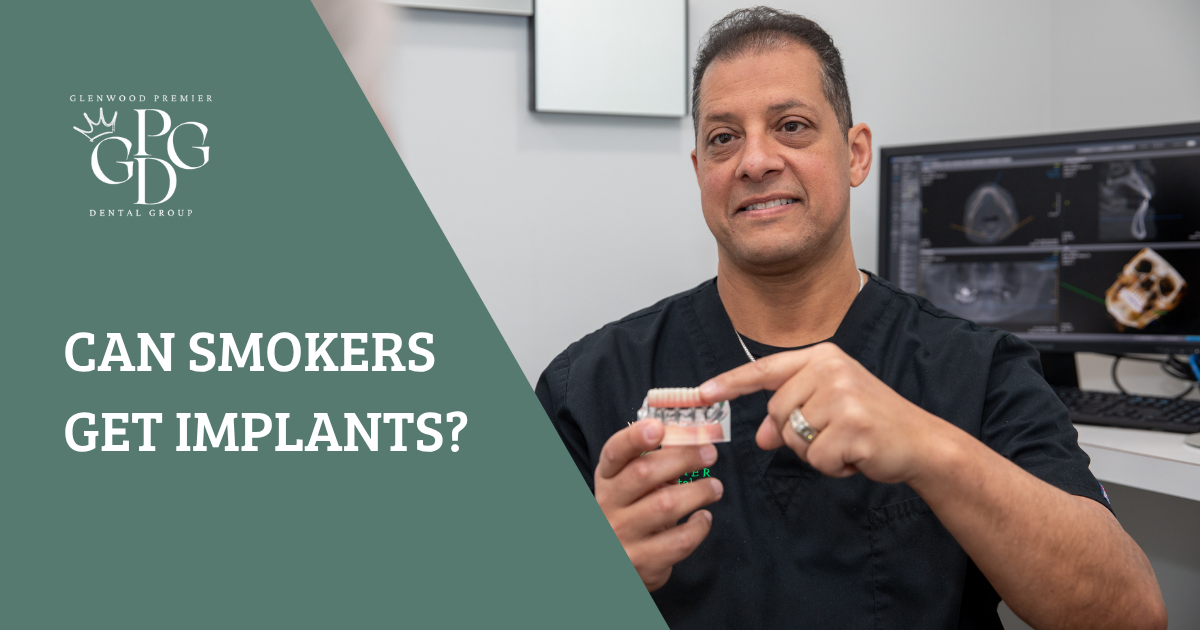
If you're a smoker researching implants and you've been told either "you have to quit" or "smokers can't get implants" without further explanation, this post is the honest version of that conversation. Quitting before surgery produces the best outcomes. Not quitting doesn't rule out treatment, but it changes what the treatment involves and what long-term maintenance requires.
Why the Honest Version Is Worth Having
Most content on smoking and dental implants leads with a moral argument: you should quit. That's true, and it's also unhelpful to the reader making a decision about their own body. Adults who smoke have heard the argument many times. Repeating it doesn't change the decision. What might change the decision is honest information about what smoking specifically does to implant outcomes, so the reader can weigh the trade-off with real numbers rather than generalities.
The other pattern in most content is dismissal. Some practices refuse to treat smokers at all. Others quietly discourage them from booking. This produces a specific outcome that isn't good for anyone: the smoker who could have received treatment with modified protocols and honest counseling instead delays care indefinitely, or accepts worse alternatives from a practice that will book them without explanation.
Neither pattern serves the reader. The honest version starts by acknowledging that smokers can receive full-arch implants, that the outcomes are measurably different from non-smokers, and that both the treatment plan and the long-term care conversation should reflect those differences.
What Smoking Actually Does to Full-Arch Implant Outcomes
At Glenwood Premier Dental Group, three specific effects of smoking matter for full-arch treatment planning. Each is measurable, and each affects a different phase of the treatment.
1. Smoking Reduces Osseointegration Success Rates
The first effect happens during the healing period, when the implants integrate with the bone. Success rates for implant integration in non-smokers consistently range from 95% to 98% across major clinical studies. Success rates in smokers range from roughly 85% to 90%, with heavier smokers (more than 20 cigarettes per day) at the lower end of that range and lighter smokers closer to the higher end.
The mechanism is direct. Nicotine constricts blood vessels, which reduces blood flow to the healing surgical site. Reduced blood flow means less oxygen and fewer nutrients reaching the bone that needs to integrate with the implant surface. Carbon monoxide from smoke further reduces oxygen delivery. The result is slower healing and, in a small but real percentage of cases, failure of the implant to fully bond with the bone.
This effect is most significant during the first six weeks after surgery, when the initial integration happens. Smokers who reduce or eliminate smoking during that specific window see better integration outcomes even if they resume afterward.
2. Smoking Increases Peri-Implantitis Risk Over Time
The second effect happens during the long-term maintenance phase, years after the initial surgery. Peri-implantitis is the inflammatory condition that causes bone loss around implants and is the leading cause of long-term implant failure. Smokers develop peri-implantitis at higher rates than non-smokers, and the bone loss progresses faster once it starts.
The specific numbers vary by study, but the pattern is consistent. Smokers show roughly twice the marginal bone loss around implants over time compared to non-smokers. In the upper jaw specifically, smokers face more than three times the risk of implant loss over the long term.
This effect compounds. A smoker who successfully integrates implants at surgery still faces a higher lifetime risk of losing those implants to peri-implantitis than a non-smoker with the same case. Long-term maintenance for smokers matters even more than long-term maintenance for non-smokers.
Understanding the five early signs of peri-implantitis every full-arch patient should recognize is particularly important for smokers, since early detection is what prevents small problems from becoming implant losses.
3. Smoking Slows Wound Healing and Increases Infection Risk
The third effect happens across the entire healing period, from surgery through the temporary phase and into long-term recovery. Smokers heal more slowly than non-smokers, and infection rates at surgical sites are higher.
The mechanism involves the same reduced blood flow described above, plus a suppressed immune response that makes it harder for the body to clear bacteria from the healing area. Smokers experience more post-op complications, take longer to recover, and are more likely to need antibiotics during healing.
Practically, this means smokers should plan for slightly longer recovery windows, more careful home care during healing, and closer follow-up with the practice than non-smokers typically need.
The Quit vs. Don't Quit Trade-Off
The honest version of this conversation requires acknowledging that most smokers researching implants aren't planning to quit permanently. Some will quit for the surgery and resume afterward. Some won't quit at all. Both patients deserve honest information about what each choice actually involves.
Quitting Before Surgery
Quitting smoking two to three weeks before surgery produces measurable improvements in outcomes. Blood flow improves. Oxygen levels normalize. Wound healing capacity approaches non-smoker levels. Patients who quit at least four weeks before surgery and remain smoke-free through the initial six-week healing period see success rates approaching those of non-smokers.
This is the option most practices recommend, and it's the option with the best short-term outcomes. For patients considering quitting anyway, using surgery as the deadline can provide the motivation that other attempts didn't.
The realistic caveat: quitting is hard, and the studies consistently show that most patients who quit for surgery resume smoking within weeks or months afterward. This produces a specific outcome pattern: better integration success in the short term, but similar long-term peri-implantitis risk to patients who never quit, because the resumption returns the mouth to the higher-risk state within the same year as surgery.
Quitting Permanently
Quitting permanently before and after surgery produces the best outcomes of any option. Success rates approach non-smoker levels for both integration and long-term stability. The lifetime risk of peri-implantitis and implant loss returns to near-baseline over several years of continued abstinence.
For patients who want to quit anyway, full-arch implant treatment provides a strong motivation and an ideal deadline. For patients who don't want to quit, this option isn't relevant to their decision.
Not Quitting
Not quitting is a legitimate choice, and it doesn't automatically disqualify a patient from treatment. Some practices refuse to treat smokers who won't quit; others treat them with modified protocols and honest expectations.
Treatment for patients who continue to smoke involves several modifications. The surgical team may use different implant sizes or placement strategies to compensate for reduced healing capacity. The initial healing period may be extended by several weeks before the temporary is loaded. Antibiotic protocols may be more extensive. Long-term follow-up visits may be scheduled more frequently to catch peri-implantitis early.
The patient should also expect that their success rates and long-term stability will be lower than a non-smoker's, and that maintenance costs over the years may be higher due to more frequent interventions. These aren't punitive adjustments. They reflect the biological reality that smoking changes healing and long-term tissue health.
Some practices will not treat smokers who won't quit. This is a legitimate practice policy, and patients who encounter it should not take it as a general disqualification. Other practices, including Glenwood, will treat smokers with honest counseling about expected outcomes and appropriate modifications to the treatment plan.
What About Vaping?
Vaping is a common alternative to cigarette smoking, and many patients ask whether it produces the same effects on implant outcomes. The honest answer is that the evidence isn't as complete as it is for cigarette smoking, but the emerging picture suggests that vaping affects implants in some of the same ways.
Nicotine is the primary agent that constricts blood vessels and reduces blood flow to healing tissue. Nicotine is present in most vape products, sometimes at higher concentrations than cigarettes. The vasoconstriction effect appears to be similar regardless of whether the nicotine comes from smoke or from vapor.
The additional effects of cigarette smoke (carbon monoxide, tar, thousands of chemicals) are largely absent from vaping. This may mean vaping is somewhat less harmful to implant outcomes than cigarette smoking, but "somewhat less harmful" isn't the same as "safe." Vapers should expect their outcomes to be closer to cigarette smokers than to non-users of nicotine.
Patients who switched from cigarettes to vaping and are considering implants should treat themselves as smokers for treatment planning purposes rather than assume vaping is neutral.
What Smokers Can Control Regardless of Whether They Quit
Even for patients who continue to smoke through and after treatment, several factors are worth attention. These don't eliminate the effects of smoking, but they can improve outcomes at the margin.
Timing matters. Avoiding smoking in the 24 hours before surgery, in the 72 hours immediately after, and during the initial six weeks of healing produces meaningful benefits even for patients who resume afterward. The most vulnerable window is the initial integration period.
Home care matters more for smokers than non-smokers. The higher peri-implantitis risk means that daily cleaning around the prosthesis, use of a water flosser, and use of interdental brushes specifically designed for implants become non-negotiable rather than optional.
Follow-up visits matter more for smokers than non-smokers. The standard six-month hygiene cadence may need to move to three or four months for smokers, and the milestone visits at year one and year five become more important for early detection of peri-implantitis. Understanding what a real one-year and five-year check-in after full-arch implants should include is worth reviewing so the patient knows what to expect and what to insist on from their practice.
Choosing the right practice matters more for smokers than non-smokers. The practice's willingness to treat smokers honestly, to modify protocols appropriately, and to provide the closer long-term follow-up smokers need is directly relevant to outcomes. Understanding the six criteria for evaluating a full-arch implant dentist is particularly relevant because case volume, long-term follow-up structure, and honest patient communication all correlate with smoker outcomes.
What to Ask a Prospective Practice as a Smoker
Three questions matter specifically for smokers researching full-arch treatment.
The first: are you willing to treat me as a smoker, with honest counseling and appropriate protocol modifications? A practice that hedges or refuses without offering alternatives is a practice that will either dismiss the case or treat it without acknowledging the trade-offs. A practice that says yes and can describe the modifications is a practice set up to serve smoker patients well.
The second: what specific modifications do you make to the treatment plan and follow-up schedule for smokers? A specific answer names the protocol adjustments (extended healing windows, more frequent hygiene visits, closer monitoring for peri-implantitis). A vague answer indicates the practice hasn't thought about smoker cases specifically.
The third: what are the realistic success rates and long-term outcomes for smokers at your practice? A practice that treats smokers regularly can give honest numbers. A practice that avoids the question is either uncomfortable with the topic or doesn't have the data.
The Choice Is Yours, and the Information Should Be Honest
Smoking and full-arch implants are compatible with honest counseling and appropriate treatment planning. Success rates are lower than for non-smokers. Long-term maintenance is more involved. Outcomes over the decades ahead are more variable. All of this is true, and none of it makes treatment impossible.
The choice about smoking is the patient's, and the practice's job is to provide honest information rather than moralize. Patients who receive that honest information make better decisions about their own bodies than patients who receive lectures.
Schedule a free consultation with Dr. Wassef at Glenwood Premier Dental Group in Hazlet, NJ. You'll get a 3D scan, a treatment plan, and an honest conversation about what treatment would look like for your specific case, whether you plan to quit smoking, plan to quit for surgery only, or plan not to quit. The consultation is where the honest version of this conversation starts.