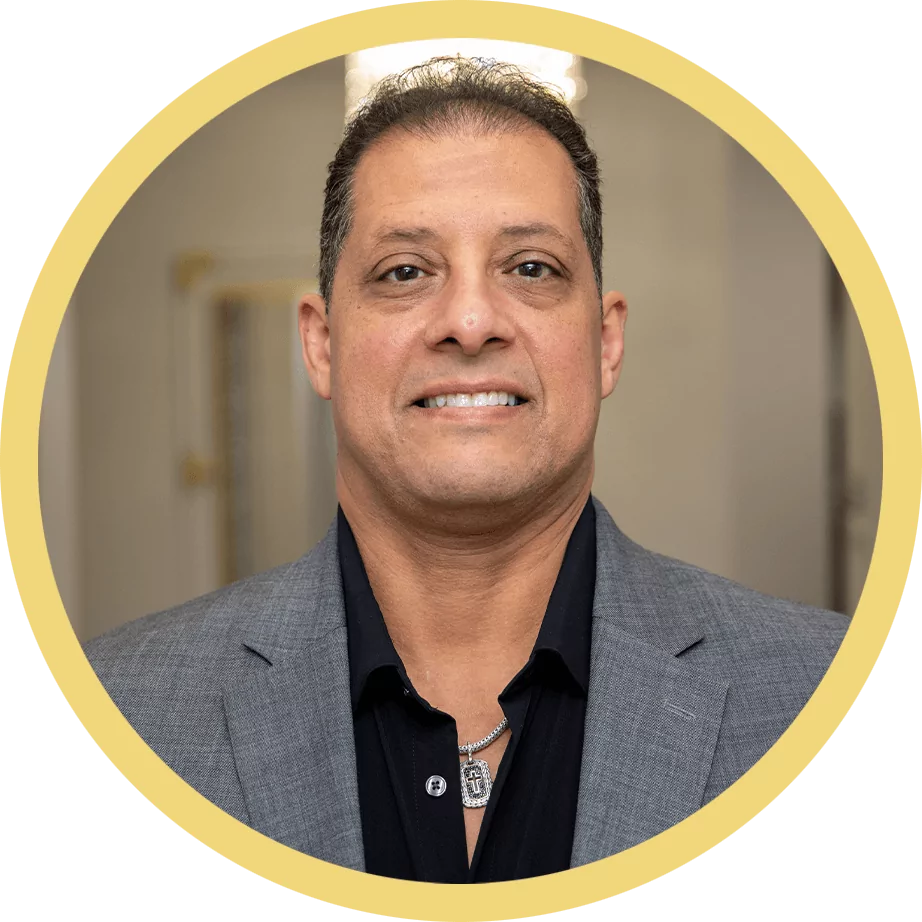
Dr. Wassef is an experienced dentist serving patients in Hazlet, Holmdel, and surrounding NJ communities. Known for precision care and personalized treatment for even the most complex cases, he’s helped countless patients save their teeth and restore their smiles.

If you've worn dentures for years, the question isn't whether you'd rather have fixed teeth. Most denture wearers would. The question is whether it's still possible for someone in your specific situation, what the evaluation would involve, and what the transition would actually be like after years of adapting to removable teeth.
The honest answers: it's possible for most long-time denture wearers, the evaluation is more involved than it would be for someone with failing natural teeth, and the transition experience has specifics worth knowing before you decide.
Why denture wearers finally consider conversion
The reasons most patients cite after years of dentures are consistent. Adhesives that used to work don't hold anymore. Chewing certain foods has become genuinely difficult. Speaking without worrying about movement has stopped feeling automatic. Social situations involve calculations about eating that weren't there a decade ago.
Underneath those specific frustrations is usually something bigger. Patients who converted to fixed implants after long-term denture wear consistently describe the same shift: they hadn't realized how much daily energy they'd been spending on their teeth until it stopped.
That energy shows up in small ways. Where to eat. What to order. How long a conversation could go before adjusting the dentures became necessary. Whether to laugh openly. Whether to accept an invitation involving certain foods. None of it is dramatic on its own. All of it adds up.
The frustration usually builds slowly, then suddenly. A single event (a meal that didn't work, a work presentation that went wrong, a family photo the patient didn't smile in) tips the calculation from "manageable" to "not anymore." That's when patients start researching what conversion would actually involve.
The bone loss question you need to ask directly
The single biggest concern most long-time denture wearers have is bone loss. That concern is legitimate. Bone resorbs after tooth loss, and denture wear accelerates the process in specific ways.
Traditional dentures rest on the gums and rely on the underlying bone for support. Every time a patient chews with dentures, the pressure transmits directly to the bone through the gum tissue. Over time, that pressure causes the bone to gradually shrink. The pattern is called ridge resorption, and it's most pronounced in the upper jaw. Patients who have worn upper dentures for ten or twenty years often have significantly less bone available in the maxilla than they had when they first got dentures.
This is real, and it's why long-time denture wearers often need approaches that patients with recent tooth loss don't need. It's also not usually a disqualification for implant treatment. Modern implant protocols have evolved specifically to work with reduced bone volume.
The All-on-4 protocol uses angled implants to engage available bone in front of the sinus, which lets many long-time denture wearers get fixed teeth without extensive grafting. When more bone is genuinely needed, ridge augmentation grafts, sinus lifts, and in the most severe cases zygomatic implants (implants anchored into the cheekbone) all give patients options that didn't exist a generation ago.
The specific question worth asking any provider evaluating you is: given my imaging, which of these approaches applies to my case, and what would treatment actually involve? A generic "you have bone loss" isn't an answer. A specific plan is.
If you've been told at another practice that you're not a candidate for implants because of your bone loss, the second-opinion post covers what to do next in detail. Many patients turned down elsewhere turn out to have options after a proper 3D evaluation.
What the evaluation should reveal for denture wearers specifically
Long-time denture wearers need an evaluation that's more thorough than the standard candidacy assessment. At Glenwood Premier Dental Group, five specific things should be assessed before any recommendation is made.
1. Current bone volume in three dimensions
A 3D CT scan (cone beam CT) shows bone width, height, and density in ways that a 2D X-ray can't. For denture wearers, the 3D view is what reveals whether existing bone supports standard implant placement, whether angled protocols like All-on-4 will work, or whether grafting is genuinely needed first.
Providers who make candidacy decisions based on 2D imaging alone are working from incomplete information. That's how patients get told they need extensive grafting they may not actually need, or told they're not candidates at all when they actually are.
2. The condition of the ridge and gum tissue
Years of denture wear affect the gum tissue as well as the bone. Some patients develop chronic gum inflammation from denture pressure. Others have areas of thinning or scarring where the denture has been pressing for years. These conditions are usually manageable but affect the treatment plan and the healing timeline.
An honest evaluation includes a look at the gum tissue as a separate consideration from the bone underneath. Both matter.
3. Bite mechanics and jaw joint health
Denture wearers often develop compensatory chewing patterns that shift how their jaw moves. Over years, that shift can affect the temporomandibular joint (TMJ) and the muscles that control the bite. Patients transitioning to fixed implants sometimes need occlusal (bite) adjustments during and after treatment to restore natural chewing patterns.
This isn't a reason to avoid implants. It's a reason to plan the transition carefully so the new bite integrates well with the patient's overall jaw mechanics.
4. Systemic health factors
The candidacy evaluation should cover diabetes control, smoking history, medications that affect healing (particularly bisphosphonates and blood thinners), and any autoimmune conditions. None of these are automatic disqualifications, but each affects the treatment plan and the expected outcomes.
Patients who've been managing well-controlled diabetes or have quit smoking recently often qualify for implant treatment on the same terms as patients without those factors. Active issues need to be addressed as part of the treatment plan.
5. Realistic expectations for the transition experience
The evaluation should also cover what the transition will actually be like for the patient, not just what's clinically possible. Patients who've been wearing dentures for years have adapted to a specific way of eating, speaking, and interacting with their teeth. That adaptation reverses during and after the transition to fixed implants, but the reversal takes time.
Practices that skip this part of the evaluation set patients up for surprises that could have been avoided. A good evaluation includes an honest conversation about what the first year with fixed implants will feel like compared to what the last decade with dentures felt like.
What the transition actually involves
The transition from dentures to fixed implants happens in stages, and each stage has specifics that matter for patients who've been wearing dentures for years.
The initial evaluation and treatment planning typically take two to four weeks, including the 3D scan and any additional consultations needed for complex cases. Some patients start treatment right after this phase. Others need preparatory work first, especially those with active gum issues, bone grafting requirements, or systemic conditions that need to be addressed before surgery.
Surgery day involves placement of the implants and, in many cases, a same-day temporary prosthesis attached to the implants. For denture wearers, this means they leave surgery with fixed teeth from day one, rather than returning to their old dentures during healing. That's a significant change from the transition patterns that were standard a generation ago.
The healing period lasts three to six months while the implants integrate with the bone. During that time, the temporary prosthesis functions as fixed teeth (patients can eat, speak, and clean it normally), but it's engineered for moderate forces rather than full bite force. Patients follow specific dietary guidelines during this period, similar to what patients with failing natural teeth follow after full-arch surgery.
The final restoration is placed after integration is complete. That's when the patient's permanent teeth (typically a zirconia prosthesis engineered for full function) go on, and the transition is complete. From this point forward, daily life looks different than it did with dentures in ways worth understanding in advance.
What life is genuinely different after conversion
The immediate changes tend to be dramatic for long-time denture wearers. Food that had become difficult with dentures becomes possible again, often within the first few weeks of the final restoration. Speech normalizes quickly because the tongue no longer has to work around a shifting appliance. The adhesive routine disappears.
The less immediate changes are also significant. Patients report freedom from the mental calculations that had become automatic — where to eat, what to order, how to sit at meetings, whether to laugh. That freedom takes a few months to fully register because the calculations had become so habitual.
The long-term picture is covered in more depth in the Life With Full-Arch Implants post, which addresses what actually changes and what doesn't over five-plus years. For denture wearers considering conversion, the important thing to know is that the changes are real and mostly positive, but they don't happen instantly. The first year involves genuine adaptation. After that, most patients describe it as forgetting they had dentures at all.
What long-time denture wearers should ask a prospective provider
Five questions separate practices that know how to handle denture-to-implant conversions from practices that treat these patients the same as any other implant case.
The first: has the provider evaluated my bone specifically with 3D imaging, and can they show me what they see? A verbal "you have some bone loss" without visual reference isn't a complete evaluation.
The second: given my bone situation, which specific protocol are they recommending, and why that one? A generic recommendation without specific reasoning isn't the level of planning this case requires.
The third: what would treatment look like if bone grafting is needed, and what would it look like if it isn't? Long-time denture wearers should understand both scenarios before deciding whether to proceed.
The fourth: what's the practice's experience with patients converting from long-term dentures specifically? This is a distinct case type from patients with failing natural teeth, and experience matters.
The fifth: what does the transition experience look like week by week, month by month, and what support will I have during it? Practices that can answer this in detail are set up to support the conversion. Practices that answer vaguely are treating conversion the way they treat any implant case, which isn't quite the same thing.
The evaluation is what tells you what's possible
If you've been in dentures for years and you're wondering whether conversion is still an option, the evaluation is where that question gets answered. A generic "you're not a candidate" from a provider without 3D imaging isn't the answer. A specific plan based on your actual bone, your gum tissue, your bite, and your health picture is.
For patients with significant bone loss who've been told no elsewhere, the second-opinion post walks through what a real evaluation should cover. For patients wondering whether their case even needs bone grafting, the bone graft post explains when it's genuinely required and when it isn't.
Schedule a free consultation with Dr. Wassef at Glenwood Premier Dental Group in Hazlet, NJ. You'll get a 3D scan of both arches, an evaluation that's specific to the long-time denture wearer's situation, and a clear conversation about what conversion would actually involve for your case. The answer isn't the same for every denture wearer, but the honest version of that answer is the one worth having.